Product sample · .NET
Northwind API
A typed minimal API in C# .NET 8: customers and orders with pagination, validation, RFC 7807 problem details and an OpenAPI document, tested with xUnit and run through Docker when the local SDK is missing.
.NET 8runtime
C#language
xUnittests
OpenAPIcontract
The problem
A small API that behaves like a real one.
Sample APIs often skip the parts that make an API usable: consistent errors, bounded pagination, a contract, and tests for validation instead of only the happy path.
Northwind API is deliberately small but complete: typed records in, typed records out, problem details on failure, and a test suite that checks both.
What we built
Types, validation, and a contract.
- Minimal API endpoints for customers and orders with typed request and response records.
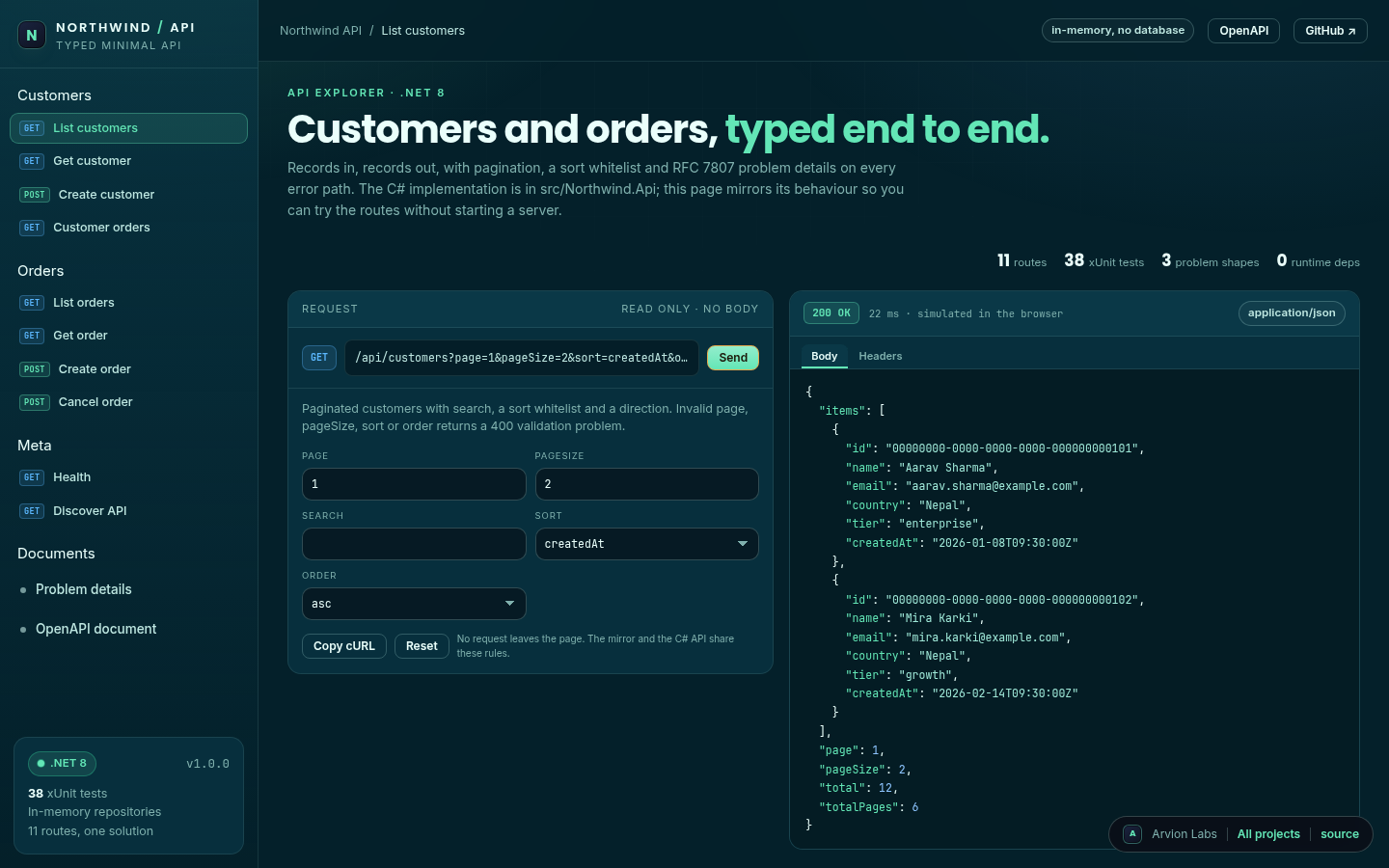
- Pagination and sorting with bounded page sizes, so a client cannot ask for everything.
- RFC 7807 problem details for validation and not-found responses.
- An in-memory repository with deterministic seed data.
- OpenAPI document generated from the endpoints, plus a static explorer demo.
Architecture
How it is put together
src/Northwind.Api/
 ├─ Program.cs (minimal API setup)
 ├─ Endpoints/ (customers, orders)
 ├─ Domain/ (records, validation)
 └─ Data/ (in-memory repository with seed)
src/Northwind.Tests/ xUnit tests for handlers and validation
scripts/test.sh runs dotnet test, with a Docker fallback
Stack
.NET 8C#Minimal APIxUnit
Security and money
- Endpoints return typed records, so the OpenAPI document and the tests describe the same shapes.
- Validation produces problem details with a field pointer, not a generic 400.
- Page size is capped, and the cap is tested, not just documented.
- The Docker fallback in scripts/test.sh keeps the test command identical on a machine without the SDK.
Screens
Product surfaces
Similar work
Building something in this category?
We can walk you through the architecture, the payment integration and the failure cases on a call, including the parts that were hard.